Skip to content
Home The Cellar Journal The Standard Join the Movement
Audécious Moonshot  ·  Collective Strength  ·  Restorative Purpose
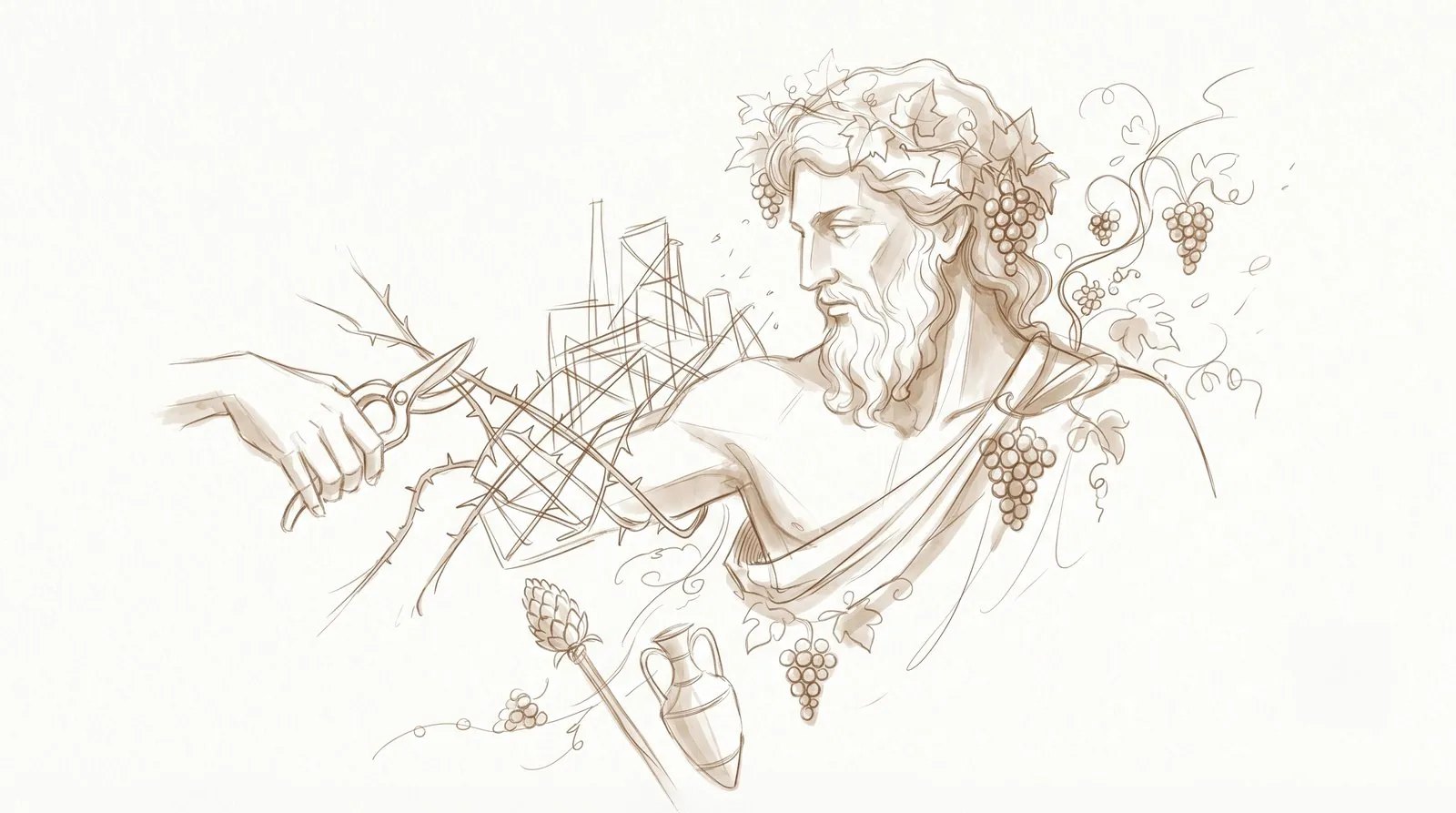
A vine-crowned figure of Bacchus breaking free from a thicket of synthetic pesticides — the Free Bacchus symbol of clean, organic wine and spirits
The Restoration of Clean Wine & Spirits

The world's first unified front for organic spirits and sustainable wines.

Not built for one brand, but to champion a global movement — a verification standard, marketplace, and advocacy platform switching the world's drink onto clean, regeneratively farmed sources.

I · Audécious MoonshotII · Collective StrengthIII · Restorative Purpose
Scroll
I Our Mission

The harm in a bottle was never the drink.
It was the farming.

The crops behind the world's wine and spirits rely on some of the most pesticide-intensive agriculture on earth — poisoning the farmworkers who grow them, collapsing pollinator populations, and contaminating the soil and water around every field and vineyard. The drinker rarely tastes it. The land always pays.

Free Bacchus exists to switch the world's wine and spirits onto clean, organically and regeneratively farmed sources — and to make that switch verifiable, so "sustainable" stops being a marketing word and becomes a measured standard.

II Traditions We Refuse To Carry

The hidden cost of a glass.

Traditional spirits carry a toxic footprint. Pesticides leach into soil, water, and air — sacrificing biodiversity worth hundreds of billions a year, all for a product meant purely for pleasure.

490M
Children Exposed

May face agricultural pesticide exposure — UNICEF, 2026

90%+
Of Commercial Spirits

Rely directly on pesticide-dependent monoculture crops

0 / 8
Major Producers

Disclose synthetic chemical or pesticide data across supply chains

<4%
Champagne Vineyards

Are certified organic — luxury branding masks the baseline

Every bottle clears two independent tests before it reaches you — verified farming, and quality corroborated by outside authorities. Published methodology. No hidden score. No pay-to-play.
III Introducing Bacchus

The liberator, taken captive.

Bacchus was the Roman god of drink and revelry — but that was a fraction of who he was. He was also the god of vegetation, agriculture, the harvest, and transformation. He presided over the entire relationship between the earth and the drink: from the soil that fed the root to the ferment that filled the cup. And the Romans knew him, above all, as the liberator. Of body. Of soul.

For thousands of years he embodied the covenant between clean land and honest craft. Then industrial agriculture arrived. Pesticides saturated the soil. The very earth he presided over was poisoned in the name of yield, efficiency, and shareholder return. The liberator became captive to a system he would never have recognized.

Bacchus, crowned with vine, cutting himself free of an industrial pesticide thicket as living vines and grapes return
Free Bacchus is the restoration.
"The vine remembers everything we put into the ground. Liberation begins in the soil."
— The Free Bacchus Charter, Article I
IV The Audécious Proof

The product worked. The ecosystem didn't.

Audécious was born in Whistler to prove outstanding spirits could be made entirely free of pesticide-dependent practices. It won. Then scaling it revealed the real barrier wasn't the brand — it was the system.

Platinum · LA Spirits AwardsDouble Gold · SIP AwardsFour Seasons · Gibbons Group · Kitchen Table Group
Product Quality

Award-winning, clean liquids that outperform legacy products bottle for bottle — built on pure ingredients and organic process.

Consumer Pull

Price-resilient, informed buyers who actively seek transparency and are immune to the marketing illusions of legacy giants.

Hospitality Demand

Consistent, unsolicited inbound from top-tier venues that want clean, narrative-driven portfolios their clientele now expects.

Global Validation

A Four Seasons listening tour across three continents confirmed it: guests want clean options the legacy system is built to keep out.

V The Founding Cellar

The makers who never stopped doing it right.

Across continents and categories, a quiet cohort has farmed clean for decades — out of view of the people who would choose them in a heartbeat. The gap was never quality. It was infrastructure. These are the first houses of the Free Bacchus standard.

Seventy-Five Houses · One Standard
The Full Cellar · Ordered by Tier & Critical Standing
The complete cellar · 75 houses
Audécious01Founding

Audécious

Whistler, BC, Canada
Organic Sugarcane Vodka
Bodega Clos des Fous69Gold

Bodega Clos des Fous

Aconcagua, Chile
Wine
Cantina Giardino70Gold

Cantina Giardino

Campania, Italy
Wine
Château Rêva71Gold

Château Rêva

La Motte, Côtes de Provence, France
Wine
Costadilà72Gold

Costadilà

Veneto, Italy
Wine
Hermosa Organic Tequila73Gold

Hermosa Organic Tequila

Amatitán, Jalisco, Mexico
Tequila
Montinore Estate74Gold

Montinore Estate

Willamette Valley, Oregon
Wine
Tsuchida Shuzo75Gold

Tsuchida Shuzo

Gunma, Japan
Sake
Château Pontet-Canet 02 Reserve

Château Pontet-Canet

Pauillac, Bordeaux, France
Wine
Domaine Leflaive 03 Reserve

Domaine Leflaive

Puligny-Montrachet, Burgundy, France
Wine
Zind-Humbrecht 04 Reserve

Zind-Humbrecht

Turckheim, Alsace, France
Wine
Château de Beaucastel 05 Reserve

Château de Beaucastel

Courthézon, Châteauneuf-du-Pape, France
Wine
Coulée de Serrant / Nicolas Joly 06 Reserve

Coulée de Serrant / Nicolas Joly

Savennières, Loire Valley, France
Wine
Cullen Wines 07 Reserve

Cullen Wines

Wilyabrup, Margaret River, Western Australia
Wine
Didier Dagueneau 08 Reserve

Didier Dagueneau

Saint-Andelain, Pouilly-Fumé, Loire Valley, France
Wine
Domaine Huet 09 Reserve

Domaine Huet

Vouvray, Loire Valley, France
Wine
Felton Road 10 Reserve

Felton Road

Bannockburn, Central Otago, New Zealand
Wine
Gravner 11 Reserve

Gravner

Oslavia, Friuli-Venezia Giulia, Italy
Wine
Querciabella 12 Reserve

Querciabella

Greve in Chianti, Tuscany, Italy
Wine
Antiyal 13 Reserve

Antiyal

Maipo Valley, Chile
Wine
Foradori 14 Reserve

Foradori

Trentino-Alto Adige, Italy
Wine
Tablas Creek Vineyard 15 Reserve

Tablas Creek Vineyard

Paso Robles, California
Wine
Bruichladdich Distillery 16 Reserve

Bruichladdich Distillery

Islay, Scotland
Organic Single Malt Scotch Whisky (Organic Barley expressions)
Nc'nean Distillery 17 Reserve

Nc'nean Distillery

Drimnin, Morvern Peninsula, Scotland
Organic Single Malt Scotch Whisky
Weingut Nikolaihof 18 Gold

Weingut Nikolaihof

Mautern, Wachau, Austria
Wine
Henschke 19 Gold

Henschke

Keyneton, Eden Valley, South Australia
Wine
Jasper Hill 20 Gold

Jasper Hill

Heathcote, Victoria, Australia
Wine
Domaine Cécile Tremblay 21 Gold

Domaine Cécile Tremblay

Morey-Saint-Denis, Côte de Nuits, Burgundy, France
Wine
Dominio de Pingus 22 Gold

Dominio de Pingus

La Horra, Ribera del Duero, Spain
Wine
Emidio Pepe 23 Gold

Emidio Pepe

Torano Nuovo, Abruzzo, Italy
Wine
Soldera Case Basse 24 Gold

Soldera Case Basse

Montalcino, Tuscany, Italy
Wine
Weingut Clemens Busch 25 Gold

Weingut Clemens Busch

Pünderich, Terrassenmosel, Germany
Wine
Weingut Wittmann 26 Gold

Weingut Wittmann

Westhofen, Rheinhessen, Germany
Wine
Álvaro Palacios 27 Gold

Álvaro Palacios

Gratallops, Priorat, Catalonia, Spain
Wine
Antica Terra 28 Gold

Antica Terra

Willamette Valley, Oregon
Wine
Bainbridge Organic Distillers 29 Gold

Bainbridge Organic Distillers

Bainbridge Island, Washington State, USA
Certified Organic American Grain Whiskey
CAwaiting Portrait
30 Gold

Château Rayas

Châteauneuf-du-Pape, Rhône Valley, France
Wine
Clos Mogador 31 Gold

Clos Mogador

Gratallops, Priorat, Catalonia, Spain
Wine
Cornelissen 32 Gold

Cornelissen

Milo, Etna, Sicily, Italy
Wine
Fontodi 33 Gold

Fontodi

Panzano in Chianti, Tuscany, Italy
Wine
The Sadie Family Wines 34 Gold

The Sadie Family Wines

Swartland, South Africa
Wine
Weingut Emrich-Schoenleber 35 Gold

Weingut Emrich-Schoenleber

Monzingen, Nahe, Germany
Wine
AA Badenhorst Family Wines 36 Gold

AA Badenhorst Family Wines

Paardeberg, Swartland, South Africa
Wine
Del Maguey Single Village Mezcal 37 Gold

Del Maguey Single Village Mezcal

Oaxaca, Mexico
Spirits
DAwaiting Portrait
38 Gold

Domaine Tempier

Le Plan du Castellet, Bandol, Provence, France
Wine
Domaine de Trévallon 39 Gold

Domaine de Trévallon

Saint-Étienne-du-Grès, Les Baux-de-Provence, France
Wine
El Sativo 40 Gold

El Sativo

Jalisco, Mexico
Organic Tequila
Gérard Bertrand 41 Gold

Gérard Bertrand

Languedoc-Roussillon, France
Wine
Littorai Wines 42 Gold

Littorai Wines

Sonoma Coast, California
Wine
Occhipinti 43 Gold

Occhipinti

Vittoria, Sicily, Italy
Wine
Prophets Rock 44 Gold

Prophets Rock

Bendigo, Central Otago, New Zealand
Wine
Radikon 45 Gold

Radikon

Oslavia, Friuli-Venezia Giulia, Italy
Wine
Rippon Vineyard 46 Gold

Rippon Vineyard

Lake Wānaka, Central Otago, New Zealand
Wine
Sorrenberg 47 Gold

Sorrenberg

Beechworth, Victoria, Australia
Wine
Tenuta delle Terre Nere 48 Gold

Tenuta delle Terre Nere

Randazzo, Etna, Sicily, Italy
Wine
Yangarra Estate Vineyard 49 Gold

Yangarra Estate Vineyard

McLaren Vale, South Australia
Wine
COS 50 Gold

COS

Vittoria, Sicily, Italy
Wine
Cowhorn Vineyard & Garden 51 Gold

Cowhorn Vineyard & Garden

Applegate Valley, Oregon
Wine
Domaine Tissot 52 Gold

Domaine Tissot

Arbois, Jura, France
Wine
Domaine Vacheron 53 Gold

Domaine Vacheron

Sancerre, Loire Valley, France
Wine
Emiliana Organic Vineyards 54 Gold

Emiliana Organic Vineyards

Casablanca, Colchagua, Casablanca, Chile
Wine
Four Pillars Gin 55 Gold

Four Pillars Gin

Healesville, Yarra Valley, Victoria, Australia
Spirits
Husk Distillers 56 Gold

Husk Distillers

Tumbulgum, New South Wales, Australia
Spirits
Journeyman Distillery 57 Gold

Journeyman Distillery

Three Oaks, Michigan, USA
Certified Organic American Whiskey
Leclerc Briant 58 Gold

Leclerc Briant

Épernay, Champagne, France
Champagne
Matetic Vineyards 59 Gold

Matetic Vineyards

San Antonio Valley, Chile
Wine
Reyneke Wines 60 Gold

Reyneke Wines

Stellenbosch, South Africa
Wine
St. George Spirits 61 Gold

St. George Spirits

Alameda, California
Spirits
SAwaiting Portrait
62 Gold

Stefano Lubiana Wines

Granton, Tasmania, Australia
Wine
Weingut Loimer 63 Gold

Weingut Loimer

Langenlois, Kamptal, Austria
Wine
Casa Noble 64 Gold

Casa Noble

Jalisco, Mexico
Organic Tequila
Millton Vineyards 65 Gold

Millton Vineyards

Manutuke, Gisborne, New Zealand
Wine
Circumstance Distillery 66 Gold

Circumstance Distillery

Bristol, England
Certified Organic English Whisky
Dulce Vida 67 Gold

Dulce Vida

Jalisco, Mexico
Organic Tequila
KOVAL Distillery 68 Gold

KOVAL Distillery

Chicago, Illinois, USA
Certified Organic American Whiskey
A standard is a promise made measurable.
Building the Standard
VI Building The Standard

Not a storefront. A standard.

Free Bacchus = the "LEED" for sustainable wine and spirits.
Years 1–2

Prove & Certify

Launch the verification standard — independent pesticide profiling, traceable sourcing, a trusted badge. Certify Audécious and a founding cohort, and seed the data engine with a marketplace where certified producers can sell.

Years 2–5

Intelligence

The badge becomes what conscious buyers and Michelin venues look for. Every transaction feeds palate and sourcing intelligence. Adoption compounds — the standard, not the storefront, becomes the draw.

Years 5–10

Become Infrastructure

The standard becomes the default reference for "clean" across wine and spirits — licensed into retail and trade as the data and compliance layer that others build on.

VII Unlocking The Three-Sided Win

One platform. Three winners.

Sustainable Producers

Direct global portals

Growers bypass expensive brokers and complicated border-compliance duties, preserving up to 30% margin.

Conscious Consumers

Verified clean sourcing

Full pesticide profiling, traceable source validation, and automated matches tailored to individual taste. What you experience is simply the confidence of knowing.

Bars & Restaurants

Unified trade portfolios

Michelin venues source verified organic portfolios directly — products otherwise locked behind shipping red tape.

VIII Why Now

The catalyst wave has arrived.

Regulatory Squeeze

The loophole is closing

Governing boards and agricultural watchdogs are tightening labeling and residue exceptions. Alcohol is losing its historic "ingredient loophole" status.

Global Trade APIs

Compliance modernized

Digital cross-border customs portals and real-time duty engines are mature — removing the distribution bottlenecks that trapped small producers.

Conscious Premium

Quality over volume

Modern buyers drink less overall but spend significantly more per bottle on transparent, verified products.

Every restoration begins with people who refuse the easy way.
Join the Mission
IX Our Team

Heart, and proven operating experience.

Kevin Yeung
Founder

Kevin Yeung

First investor and Founding Chairman of GogoVan, backing an idea into a logistics platform spanning Asia. Co-founder of Feeding Hong Kong, the city's largest food bank. Champion of Egret Therapeutics from concept to a drug platform for concussion, heart attack, and stroke. Former Fundraising Chairman for UNICEF.

Umberto Luchini
Brand & Growth

Umberto Luchini

A global adventurer who has redefined industries — shaping landmark partnerships for Ferrari's Formula 1 team, then, as CMO of Campari, spearheading Aperol's rise from regional aperitif to global phenomenon. He believes in a fairer, more sustainable future, and in building it.

IX Questions, Answered

What drinkers ask us

What is Free Bacchus?
Free Bacchus is a curated direct-to-consumer marketplace for certified-organic and verified chemical-free wine and spirits. Every producer is independently verified against the Free Bacchus Verification Standard before being listed, so you can trust exactly what's in the bottle. In a market where “natural,” “sustainable,” and “clean” are used freely and proven rarely, Free Bacchus exists to show you the evidence — not just the claim.
How does Free Bacchus verify producers?
Verification uses two tracks. Track A requires formal third-party certification from a recognized body such as Demeter, USDA Organic, Soil Association, or Ecocert — the only path to our highest tier. Track B is for producers who farm without synthetic chemical inputs but hold no formal certification; it demands independent corroboration from multiple sources, direct confirmation of practice, and a specific reason certification wasn't pursued. Separately, every producer's quality is corroborated by recognized outside critics and competitions. Clean farming and great drinking are two different promises, and we verify both. Our full methodology is published openly.
What categories of drinks does Free Bacchus cover?
Free Bacchus covers wine, spirits, and sake. Within those, our verified producers span organic and biodynamic wine, organic whisky, additive-free and organic tequila and mezcal, organic vodka, agricole rum, and craft gin — sourced from producers across the United States, Europe, Latin America, Australia, New Zealand, and beyond. Every category is held to the same verification standard, whatever the bottle.
What do the Free Bacchus tiers mean?
Every listed producer is assigned a tier based on a 100-point evaluation combining verified farming practice and independently corroborated quality. Reserve is the highest — reserved for formally certified producers with an exceptional quality record. Gold recognizes producers with rigorous certification or verified practice and strong critical standing. Tiers give you an at-a-glance read on both how a producer farms and how well they make what they make. Producers that don't clear our evidentiary threshold aren't listed at all.
Why aren't most commercial wines organic?
Because for most of the last century, no one made them prove otherwise. Wine and spirits are largely exempt from the ingredient-labeling laws that govern the rest of what we consume, so conventional producers can use synthetic pesticides, herbicides, and a range of undisclosed additives without ever telling you. Organic and biodynamic farming is slower, harder, and more expensive — and without a label requirement or a way for drinkers to find them, many of the producers doing it right have stayed invisible. Free Bacchus exists to make them visible.
How can a producer join Free Bacchus?
We're always looking for producers who farm clean and care deeply about what ends up in the bottle. If that's you, we'd love to hear from you. The process is simple and collaborative: we'll get to know your practices — through your certifications, or through the story and evidence of how you farm — and how your wines or spirits are received. There's no fee to be part of Free Bacchus, and no paying your way onto the platform. If your commitment to honest, sustainable production is real, we'll work to help you shine alongside the growers and makers already championed here. Reach out through our producer page — we read every message.
X The Journal

Stories from the Liberation

Whisky

The Whisky Island That Forgot How to Grow Barley

Islay made its famous drams from mainland barley for generations. One distillery has spent two decades changing that — and refusing to hide what it costs.

Read · 9 Min
Spirits

The Plant That Waits Eight Years

The agave waits eight years in the field. How much of that patience survives the journey to your glass — and who kept faith with the plant.

Read · 8 Min
Soil

The True Cost of the Sprayed Harvest

490 million children exposed, 385 million poisonings a year — and the houses refusing to be part of it.

Read · 8 Min
Craft

Ten Feet Down: The Perennial Grain Rewriting Beer

Inside the Kernza® fields where every harvest leaves the land richer than it found it.

Read · 6 Min
Wild

What Returns When the Spraying Stops

Pollinators, songbirds, watershed life — the quiet audience of the organic estate.

Read · 5 Min
Education

Organic, Biodynamic, Natural: What the Words on the Bottle Actually Mean

Four terms, four different promises — and why some of the greatest wines on earth have been quietly biodynamic for decades.

Read · 7 Min
Industry

If It Was This Hard for Waterford, Imagine the Ones You've Never Heard Of

One of the most celebrated sustainable distilleries of its generation nearly disappeared — and why that should worry you about the ones you've never heard of.

Read · 7 Min
Producer Spotlight

The Vineyard That Gave Itself Away

How a former alfalfa farm became the first Regenerative Organic Certified vineyard on earth — and the conscience of American wine.

Read · 8 Min
Scroll for more →

Ready to switch?

join@freebacchus.com  ·  www.freebacchus.com
Pesticides 0Synthetic Inputs 0Living Soil 100%
Join the Movement

The honest bottle, delivered monthly

New verified producers, new Journal stories, and first word on the launch cellar. No noise, no selling of your address — ever.

Free Bacchus · Verification Standard
The Free Bacchus Verification Standard

Two tests.
No exceptions.

Every producer on Free Bacchus is evaluated on two entirely separate axes — and must clear a minimum bar on both. Strong sustainability practice does not excuse weak quality, and critical acclaim does not excuse undisclosed chemical use. The two layers are never blended into a single hidden score; each is independently visible.

Section 1

Two independent layers of verification

This is the public methodology behind the standard — the criteria every producer must meet to be listed. It is published in full, including the parts that are imperfect or asymmetric across categories, because a standard that hides its own limitations is not one the industry can trust.

Sustainability VerificationWhether the producer's farming and production is certified organic, or independently verified as chemical-free in practice. Controlled by Free Bacchus, using the published checklist in Section 2.
Quality CorroborationWhether the producer's quality, history, and rarity are independently recognised by established outside authorities. Controlled by external critics, publications, and competitions — never Free Bacchus's opinion alone.
Section 2

Sustainability verification — the published checklist

Every producer must qualify under one of two tracks. There is no third path. A producer who qualifies under neither is not listed, regardless of quality, fame, or critical acclaim.

Track A

Certified Organic

The producer holds active, current third-party organic certification from a recognised accredited body — among them Demeter, USDA Organic, Ecocert, CERES, BioGro, Soil Association, and Naturland. The list is not exhaustive: Free Bacchus will recognise any body that conducts independent third-party audits to an equivalent evidentiary standard. Track A is the only path to the highest listing tier, and carries full point eligibility with no cap.

Track B

Verified Chemical-Free Practice

Some genuinely excellent producers farm without synthetic inputs but hold no formal certification — often for reasons of cost, philosophy, or regional infrastructure that does not yet serve their category. Track B exists so they are not unfairly excluded. It is deliberately difficult to qualify for, and the bar is non-negotiable. A producer qualifies only when all three conditions are met:

  1. Independent corroboration from two or more sources that are not the producer itself — an importer, a sommelier, a journalist, a third-party publication — describing the farming practice.
  2. Direct or near-direct confirmation from the producer or their importer of the specific practices in question.
  3. A named, producer-specific reason why formal certification has not been pursued. A generic industry trend toward natural farming is not sufficient; the reason must be specific to that producer.

Producers verified under Track B are capped at the second-highest listing tier, regardless of quality score — because formal certification carries an independent audit and renewal process that Track B, by definition, does not. The cap reflects that difference in evidentiary strength honestly, rather than treating the two tracks as equivalent.

Section 3

Quality corroboration — why the method differs by category

Free Bacchus does not score quality on its own internal opinion. Every producer's quality, history, and rarity must be corroborated by recognised outside authorities — a deliberate check against marking our own homework.

Here is the part we are direct about rather than quietly working around: the strength and structure of outside authority is not the same across every category. Wine and brandy have the deepest individual-critic traditions, built over roughly half a century of scored, independently-named reviewing. Whisky and gin have credible scored traditions anchored by specialist publications. Rum draws on a small number of cross-category experts alongside competitions. Sake and tequila have no equivalent individual-critic scoring tradition in English at all — authority takes the form of competitions and recognised expert voices.

Section 4

Quality corroboration by category

WineJames Suckling · Wine Advocate · Jancis Robinson · Wine Spectator · Vinous / Antonio Galloni · Decanter
WhiskyWhisky Advocate · International Wine & Spirit Competition · World Whiskies Awards
SakeJohn Gauntner · Zenkoku Shinshu Kanpyokai (National New Sake Competition) · International Wine Challenge, sake category
Tequila & AgaveWine Enthusiast spirits (incl. Kara Newman) · Agavos Awards · San Francisco World Spirits Competition
RumDave Broom · IWSC rum category · San Francisco World Spirits Competition
GinDave Broom · IWSC gin category · The Gin Guide Awards
Brandy & CalvadosWine Advocate · Decanter · Wine Spectator · Jancis Robinson · IWSC brandy & Calvados
VodkaThe Spirits Business Vodka Masters · San Francisco World Spirits / IWSC vodka · Wine Enthusiast spirits
Section 5

Versioning & changelog

The standard is a living methodology. Every revision is dated, versioned, and accompanied by a one-line explanation of what changed and why — published in full and never edited retroactively without a visible note.

v1.0Initial standard. Certification required, no exceptions — a single-track model. Covered wine only.
v2.0Introduced the two-track system to fairly account for producers whose practices exceed certified peers but who cannot or choose not to certify. Track B capped at the second-highest tier. Expanded to whisky, sake, and tequila & agave.
v2.1Added Ecocert to recognised bodies. Corrected wine's critic-tradition description to its roughly half-century history. Added five categories — rum, gin, brandy & Calvados, and vodka — each with explicit corroboration methods and category-specific transparency notes.
Free Bacchus Verification Standard · Public Methodology, published in full
Free Bacchus · Verified House